A hummingbird, 80 triangles, and a local LLM
When Andrej Karpathy published autoresearch, the idea stuck with me: point an AI agent at a training script, give it a fixed experiment budget and a metric it cannot fake, and let it iterate overnight while you sleep. His README jokes that frontier research “used to be done by meat computers”. The joke lands because the loop actually works.
What I kept wondering was how far the same loop goes when nothing leaves the laptop. The agent here is Qwen3.8-27B, a 27B open-weight model that benchmarks at the level of Claude Opus 4.6, the frontier model Anthropic shipped in February 2026. When I first worked with Opus 4.6, I would never have believed that a couple of months later something at that level would be running on our laptops. It is, and it changes what “local” means: the whole research loop, agent included, runs on-device. No cloud inference anywhere.
The result is triangle-art. Qwen3.8-27B (via Ollama, quantised) evolves one Python function for 40 generations. The function’s job: approximate a target image using at most 80 translucent grey triangles.
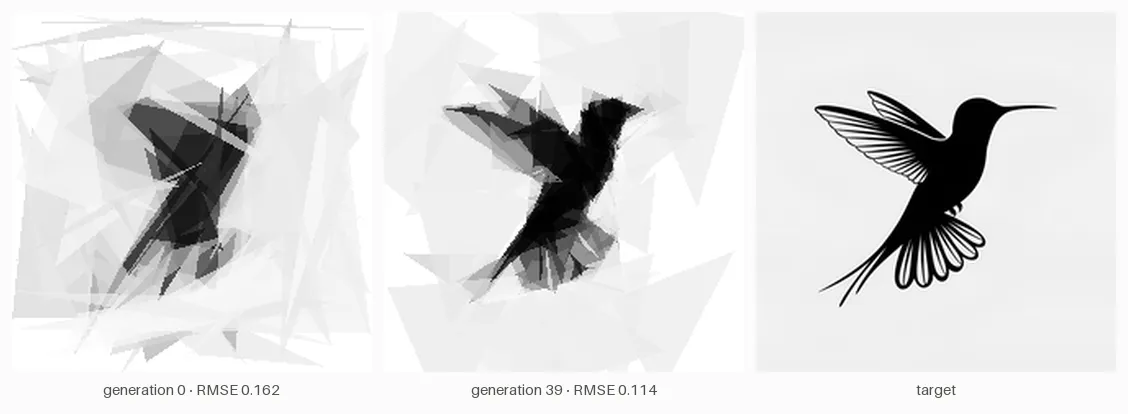
Same frozen harness, same budgets, two versions of one evolved function. Left: generation 0, random search, RMSE 0.162. Middle: generation 39, RMSE 0.114. Right: the target.
The game
This is the FunSearch and AlphaEvolve recipe, shrunk to laptop size. The model never touches the scoring. It evolves exactly one function:
def propose_triangle(target, canvas, t, n_total, evaluate, rng):
    """Called once per triangle slot. Return the best candidate found,
    or None to skip."""
Everything else is frozen. The canvas starts white. A painted triangle pushes
its pixels 65% of the way toward one grey level. For each of the 80 slots, the
heuristic may call evaluate(pts, g) at most 45 times; the call rasterises a
candidate triangle and returns the exact change in squared error if it were
painted now. Call 46 raises an exception and the run scores worst-case. Every
generation of every heuristic gets an identical budget, so the fitness curve
measures algorithmic quality, not compute.
Fitness is RMSE against the target, averaged over three training images (the hummingbird, a mountain, a tree). Two held-out images are scored only when a new champion is accepted, and the model never sees them.
Two details did the heavy lifting for honesty:
- Scores come from pixels, not claims. The heuristic returns a candidate tuple including its claimed error delta. The harness ignores the claim, re-rasterises the triangle from its vertices and grey level, recomputes the true delta, and paints only if it is a real improvement.
- Failures are data. Crashes, budget busts, and malformed replies score worst-case, and the error text is fed back into the next generation’s prompt. Roughly a third of all candidates failed. The loop survived all of them.
Generation 0 is a deliberately naive baseline: random vertices, random grey, keep the best of 45 tries. It scores a mean RMSE of 0.240 and its hummingbird is the mess on the left above. Before the run, I built a reference heuristic (error-guided placement, compact shapes, size annealing, optimal grey, a propose-then-refine budget split) to confirm the task had headroom. It scores 0.162. The model was never shown it.
What the model discovered
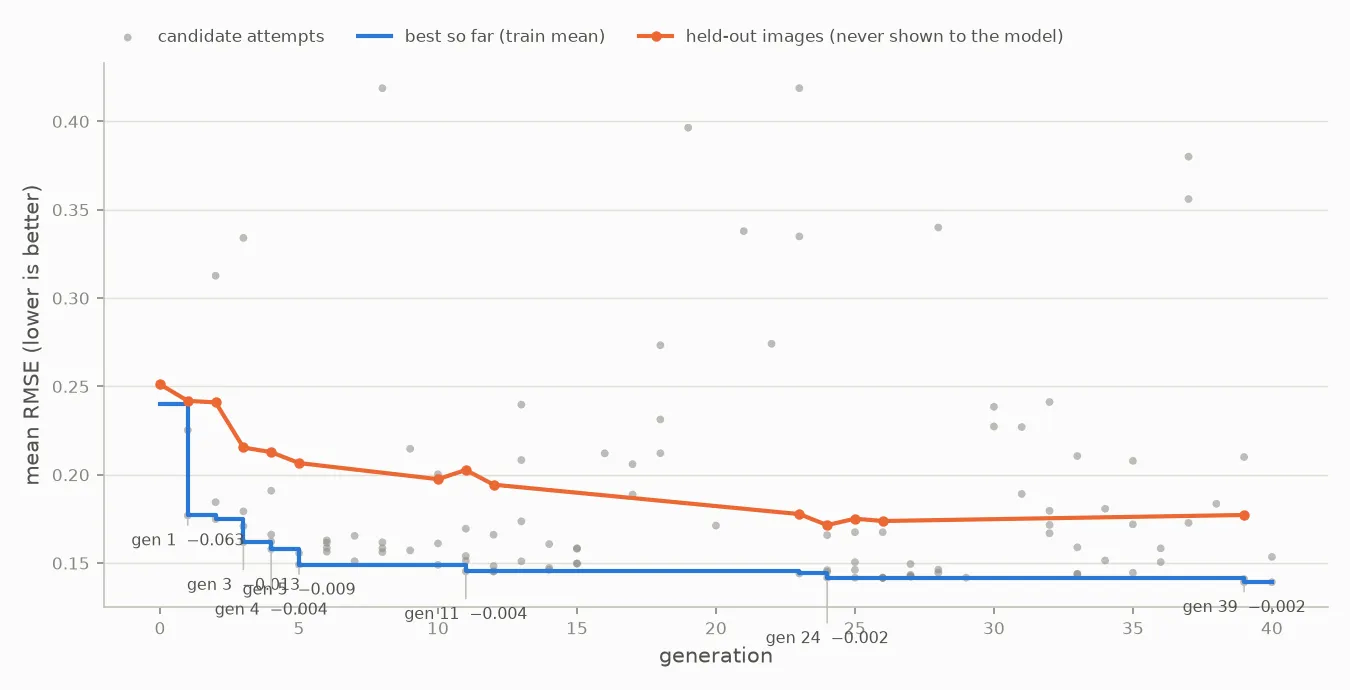
Mean RMSE across the three training images (blue, lower is better), every scored candidate (grey), and the two held-out images (orange).
The run took about 13 hours. Twelve generations produced an accepted improvement, and the rationale log reads like a compressed research diary.
Generation 1 was the big one: the model replaced blind random search with sampling centred on the residual (where target and canvas disagree most), and switched to the harness’s least-squares optimal grey. One generation, two of the reference’s five ideas, and RMSE dropped from 0.240 to 0.177.
Generations 2 to 5 added the rest, and some things I had not written down: arbitrary triangle shapes instead of equilateral ones (“a triangle that should be wide-and-flat is poorly matched”), then a proper local refinement stage using deterministic coordinate descent on each vertex, then smarter budget splits between exploring and refining. By generation 5 it was at 0.149, already ahead of the reference on the hummingbird.
Then a ten-generation plateau. The loop’s response is scripted: after three stagnant generations the prompt escalates to a bold-rewrite mode, one candidate per generation restarts from the naive baseline, and the model is shown a side-by-side image of its own best canvas against the target. Most of what came back was worse, which is what exploration looks like. The breakthrough at generation 23 was a genuine strategy change: stop grinding one triangle per slot to a local optimum, and instead spread candidates so the 80 slots tile the image (“stop piling overlapping blobs on the same spot”).
The final champion, found at generation 39, scores candidates by how much residual their area can actually absorb, which stops it wasting triangles on regions that are already right. Final mean RMSE: 0.139. It places all 80 of its 80 triangles on every image; the baseline managed 60 to 76 before running out of improving moves.
The part I find most satisfying: the model beat the reference heuristic by 14%, using at least one idea I did not have.
Watching the hummingbird come into focus
The metric is RMSE, but the metric a lay audience perceives is recognisability. They agree.
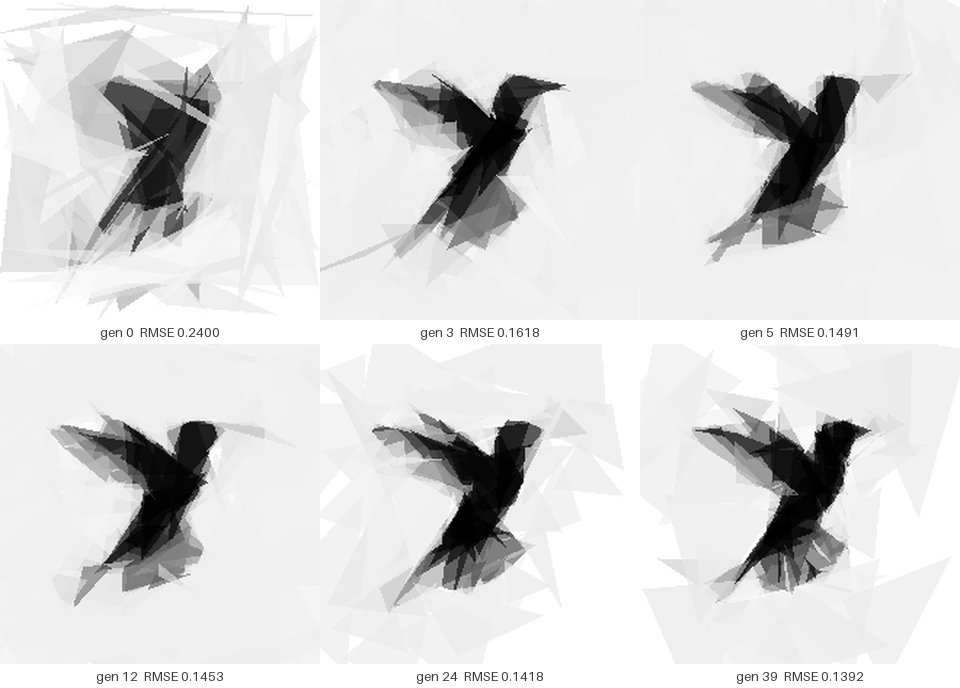
The best canvas at each accepted generation. Each frame is a better algorithm, not more compute.
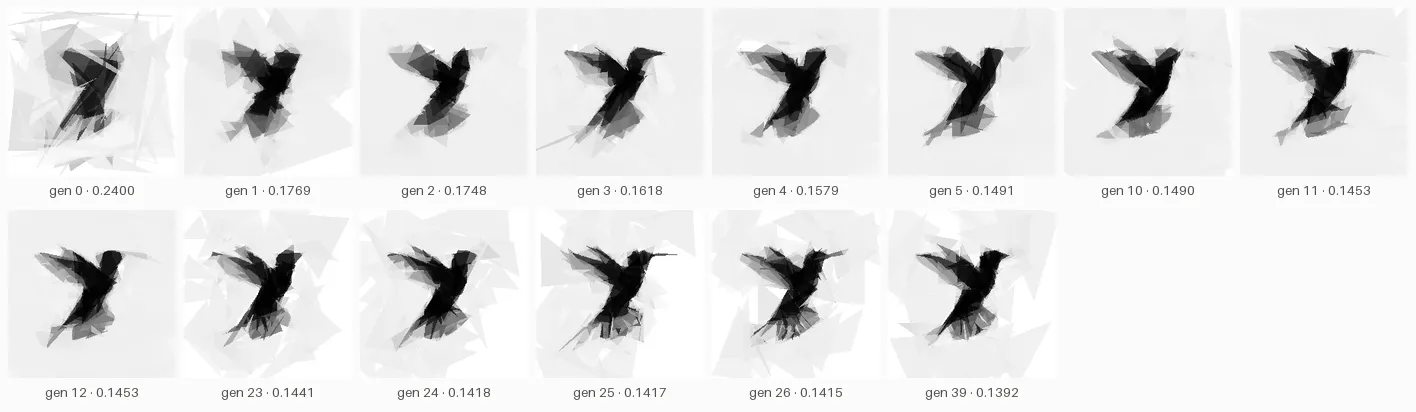
The same journey as stills, with the champion’s mean RMSE under each frame.
And within a single run of the final champion, you can watch its strategy: big tonal blocks first, detail later. Nobody told it to do that.
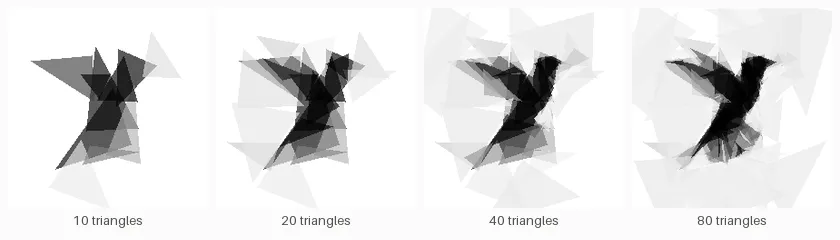
The champion’s canvas at 10, 20, 40, and 80 triangles.
What a bigger budget buys
The heuristic was evolved against a hard budget of 80 triangles, but it never
hard-codes that number: it reads the slot index t and the total n_total,
so its coarse-to-fine strategy rescales to any budget. Handing the same frozen
function 1000 triangles, a budget it never saw during evolution, produces
this:
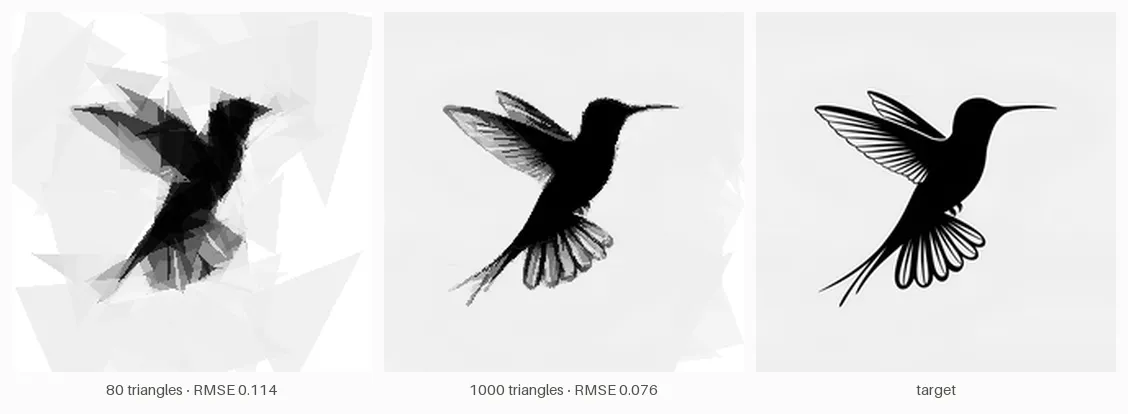
The same champion function at 80 and at 1000 triangles. At 1000 it places 987 of them, resolves individual wing feathers and the tail fan, and takes the hummingbird from RMSE 0.114 to 0.076. The run takes about 3 seconds.

The same run, triangle by triangle: big tonal blocks, then the silhouette, then feathers.
Did it generalise?
The orange line in the fitness curve is the honest one: two images the model never saw, scored only on accepted generations. They improved from 0.251 to 0.177 mean RMSE, tracking the training curve the whole way down. No overfitting to the three training compositions, which is what the multi-image fitness was designed to force: image-specific tricks simply do not pay.
The evolution loop is the simple part
Worth being honest about the search itself: it is close to the simplest thing that could work. A population of six programs, four candidates per generation on a temperature ladder, strict keep-the-best selection, and two scripted escape hatches when progress stalls (a bold-rewrite prompt, and one candidate restarted from the naive baseline). That simplicity is visible in the fitness curve. Both long plateaus are the population converging to near-clones of the incumbent, and both times it took the scripted diversity injection, not the selection pressure, to break out.
The serious versions of this recipe search much harder. FunSearch ran many islands in parallel with migration between them, so diverse lineages survive long enough to pay off. AlphaEvolve keeps a quality-diversity archive, so a structurally different program is retained even while it loses on raw fitness, and it evolves its prompts alongside its programs. Add evaluation cascades, crossover between the best programs, and richer feedback (per-image error breakdowns rather than one number), and none of it is exotic: each is roughly an afternoon of work in this codebase.
That is what makes the result encouraging rather than final. The most naive loop I could write, driving a laptop-sized model, still beat the validated reference by 14%. Search quality is the cheapest upgrade left on the table, and the fitness curve suggests the model had more to give than the loop knew how to ask for.
What made the demo work
My first attempt at this was a string-art task, and it failed as a demo for an instructive reason: the greedy baseline already looked good, so there was nothing for the audience to watch improve. The lesson generalises. If you want an evolution demo to land, the baseline has to fail visibly, and the gap between baseline and validated reference has to decompose into several independently discoverable ideas, each small enough for one generation.
The other load-bearing choices: a metric the model cannot fake (re-verify everything from raw outputs), identical evaluation budgets per generation, deterministic seeds so every score is reproducible, and feeding failures back as prompt context instead of discarding them.
Everything is in the repo, including every generation’s prompt, reply, candidate code, scores, and canvas: github.com/sachinkahawala/triangle-art. A full evaluation of one candidate takes about a second on an M-series MacBook; the 40-generation run is an overnight job with the 27B model doing the thinking. Karpathy’s meat computers are doing fine, but it is getting genuinely hard to tell where the laptop stops being the limiting factor.